
seo site structure best practices
Organizing Multi-Service Websites for SEO Success
April 13, 2026
Organizing Multi-Service Websites for SEO Success
Adding new services to your growing business is an exciting milestone. However, continually adding new pages to your website without a clear plan can quickly create a tangled mess. Visitors become lost, navigation menus become cluttered, and search engine crawlers struggle to understand what your website is actually about.
If your company offers multiple services, having a clear and organized website architecture is essential. A logical setup tells Google exactly which pages are the most important and how they relate to one another. This helps search engines index your content correctly, leading to higher rankings and better visibility. Just as importantly, it helps potential customers find the exact service they need without frustration.
Applying SEO site structure best practices allows you to scale your online presence smoothly. You can add new offerings, target specific locations, and build authority in your industry. Read on to discover the core concepts of structuring a multi-service website to maximize your search engine performance.
Create a Flat, Logical Hierarchy
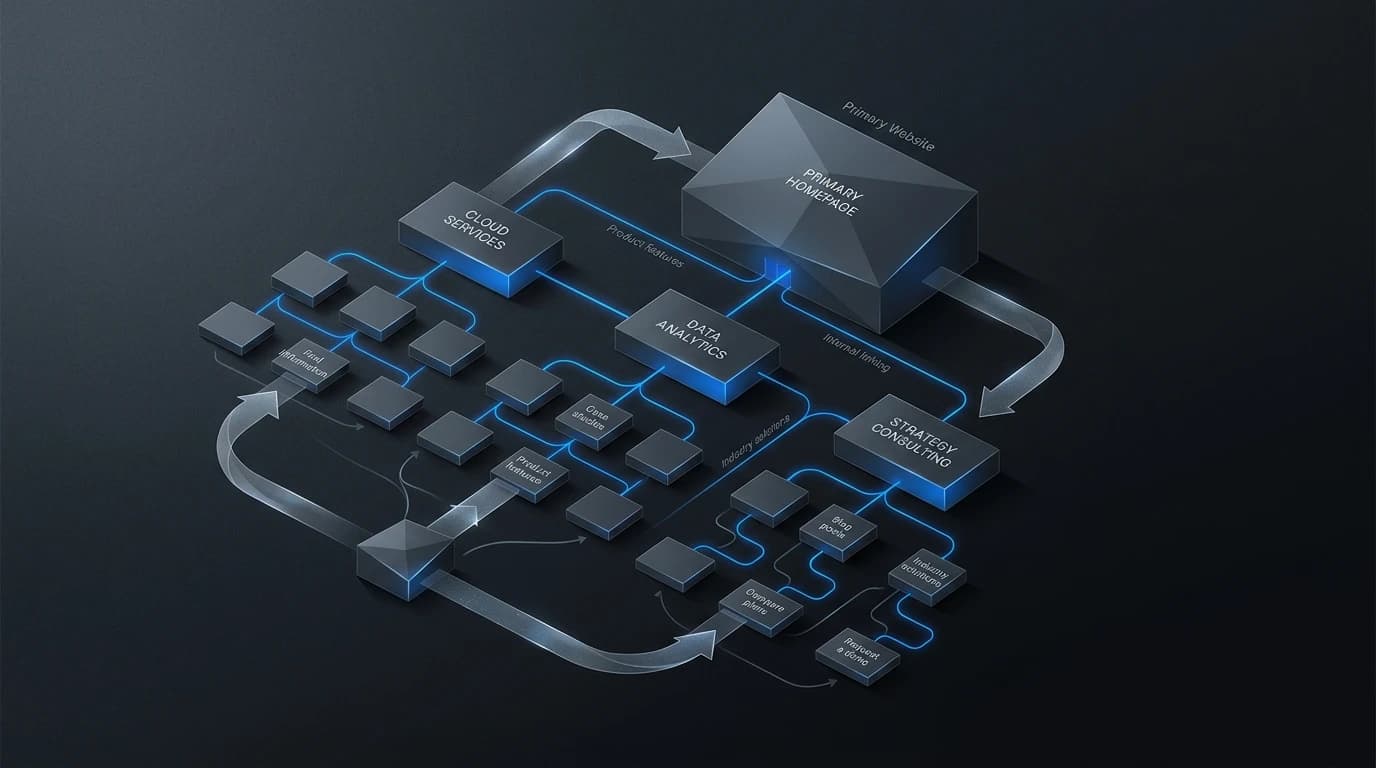
A website's hierarchy is the foundation of its SEO site structure. As a general rule, a "flat" architecture is highly recommended. This means that any page on your website should be accessible within three to four clicks from the homepage. A flat structure ensures that search engine crawlers can easily reach and index all your service pages, while users can find information quickly.
When you offer multiple services, organizing them into a clear hierarchy prevents your main navigation from becoming overwhelming. You should establish parent categories for your broad services and nest specific sub-services beneath them.
The Hub-and-Spoke Model
Consider a home improvement business that offers plumbing, electrical, and HVAC services. Instead of listing every single minor repair on the main menu, they should create three main "hub" pages: one for Plumbing, one for Electrical, and one for HVAC.
Under the Plumbing hub, you would link out to the "spoke" pages: Leak Repair, Pipe Installation, and Drain Cleaning. This logical grouping signals to search engines that the Plumbing page is a comprehensive resource, boosting its authority while keeping the website organized for the user.
Optimize URL Structures
Your URLs should act as a clear map of your website's hierarchy. Search engines read URLs to gather context about a page's content, and human users look at URLs to understand where they are on your site. Clean, descriptive URLs are a fundamental part of SEO site structure best practices.
Avoid using auto-generated URLs that contain random strings of numbers or confusing parameters. Instead, use recognizable words separated by hyphens. Ensure that the URL reflects the path the user took to get to the page.
Clean URL Examples
Following the home improvement business example, an optimized URL structure looks like this:
www.domain.com/plumbing/leak-repair
This is vastly superior to a messy URL like:
www.domain.com/services/item-12345
The optimized URL clearly indicates that "Leak Repair" is a sub-category of "Plumbing." It includes relevant keywords naturally, giving search engines immediate context about the page's topic.
Implement Strategic Internal Linking
Internal linking is the connective tissue of your website. Links passing from one page to another distribute "link equity" or ranking power throughout your site. For a multi-service website, strategic internal linking helps search engines discover new pages and establishes relationships between different topics.
When you publish a new blog post, you should actively look for opportunities to link back to your core service pages. This drives relevant traffic to pages designed to convert visitors into customers. For a deeper process, use an internal linking strategy alongside your architecture work.
Using Breadcrumbs and Contextual Links
Breadcrumbs are a secondary navigation scheme that reveals the user's location on a website. They typically appear at the top of a page (e.g., Home > Plumbing > Leak Repair). Breadcrumbs provide an excellent internal linking structure automatically and make it incredibly easy for users to navigate back to a parent category.
Contextual links are placed within the body text of your pages. If you write a blog post about "Signs You Have a Hidden Water Leak," you should include a natural, contextual link to your "Leak Repair" service page. This passes authority from the blog post directly to your service page, boosting its SEO performance.
Manage Keyword Cannibalization
A common trap for growing multi-service websites is keyword cannibalization. This occurs when you have multiple pages targeting the exact same search query. When search engines cannot determine which page is the primary resource for a topic, they may lower the ranking of all competing pages.
As you expand your service offerings, you must ensure that every page serves a unique purpose and targets a distinct keyword intent.
Consolidating vs. Separating Pages
If you find that your "Residential Plumbing" and "Home Plumbing Services" pages cover the exact same information, it is best to consolidate them. You can merge the content into one comprehensive page and set up a 301 redirect from the old page to the new one.
Conversely, if you offer a specific service in multiple cities, you should separate those pages. A dedicated page for "Plumbing Services in Chicago" and another for "Plumbing Services in Evanston" prevents cannibalization because the geographical intent is entirely different.
Balancing UX and SEO: A Potential Challenge
While implementing a strict SEO hierarchy is crucial, it can sometimes conflict with user experience (UX) preferences. For instance, SEO best practices suggest grouping related pages under parent hubs. However, if your business has dozens of sub-services, your dropdown menus can become massive and difficult to use on mobile devices.
To navigate this challenge, use mega menus cautiously. Design them to display parent categories clearly, using distinct columns for sub-services. Prioritize the most popular services in the main navigation, and allow users to click on the parent category page to view a full list of everything you offer. Always test your navigation on mobile devices to ensure that the layout remains intuitive and easy to tap.
Laying the Groundwork for Future Growth
Structuring a multi-service website requires thoughtful planning. By establishing a flat hierarchy, creating clean URLs, utilizing strategic internal links, and avoiding keyword cannibalization, you build a foundation that search engines understand and reward. These steps ensure that as your business adds new services, your website can accommodate them without losing ranking power.
Take the time to audit your current website architecture. Map out your existing pages, identify any orphaned content that lacks internal links, and reorganize your services into logical parent categories. Implementing these SEO site structure best practices will guide valuable organic traffic directly to your most important service pages. A strong content hub strategy can extend that structure into your blog.