
internal linking strategy
Internal Linking Strategy: Build Topical Authority
February 21, 2026
Internal Linking Strategy: Build Topical Authority
Most website owners obsess over acquiring external backlinks. They spend countless hours doing outreach, negotiating placements, and writing guest posts. Yet they often ignore a highly effective SEO mechanism right at their fingertips.
Internal linking is the practice of connecting one page on your website to another. It helps search engines navigate your site, distributes page authority, and establishes your brand as a subject matter expert. Search engine crawlers rely on these links to discover new content and understand the relationship between different topics on your domain.
When you thoughtfully organize these connections, you signal to search engines that your site thoroughly covers a specific subject. By strategically linking your pages, you can build topical authority and improve your overall search rankings without sending a single outreach email.
Understanding Topical Authority
Topical authority is a measure of credibility. Search engines like Google want to provide users with the most accurate and comprehensive answers possible. If your website covers a broad subject from multiple angles, Google is more likely to view you as a trusted source.
Instead of ranking a single post based purely on its individual keyword optimization, search engines look at the surrounding context. A site with 50 interconnected, high-quality articles about "digital marketing" will generally outrank a site with just one isolated post on the same subject. Internal links act as the pathways that connect these articles, proving to crawlers that your content represents a deep, cohesive library of knowledge.
Steps for a Powerful Internal Linking Strategy
Creating a web of relevant links requires planning. Randomly dropping links into your text will not yield the best results. Here are the core steps to develop an effective strategy.
Map Out Your Pillar and Cluster Content
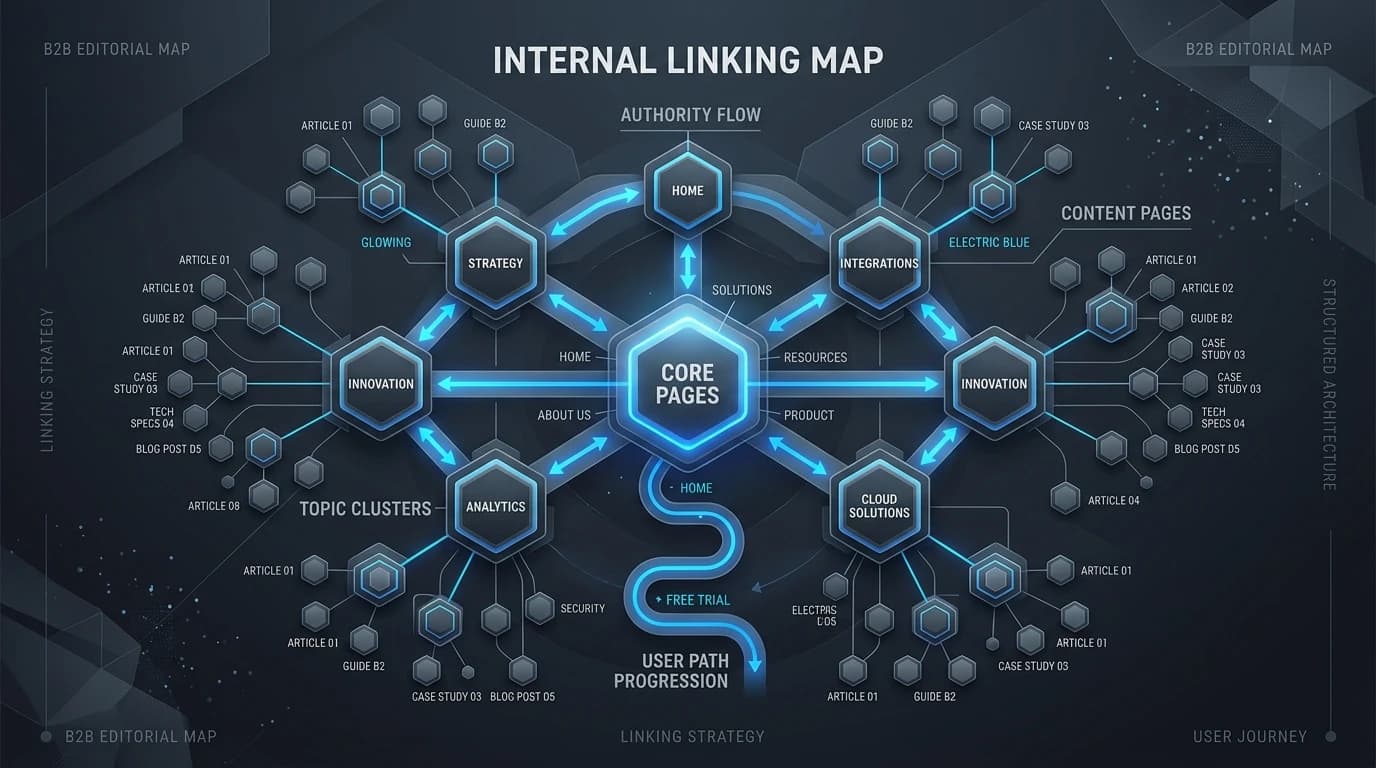
The most proven method for organizing internal links is the topic cluster model. This involves creating a comprehensive "pillar" page that provides a broad overview of a core subject. You then create multiple "cluster" pages that explore specific subtopics in detail. This approach overlaps heavily with a broader content hub strategy.
For example, your pillar page might be a definitive guide to content marketing. Your cluster pages would cover specific angles like email newsletters, blog writing, and video production. Every cluster page should link back to the main pillar page, and the pillar page should link out to the clusters. This two-way linking structure clearly defines the hierarchy of your site.
Use Descriptive Anchor Text
Anchor text is the visible, clickable text in a hyperlink. Search engines use this text to understand the context of the destination page. Using generic phrases like "click here" or "read more" wastes a valuable optimization opportunity.
Instead, use descriptive, keyword-rich anchor text. If you are linking to a cluster page about email newsletters, your anchor text should be something like "strategies for email newsletters." Be careful to vary your anchor text naturally. Using the exact same phrase for every link can appear manipulative to search engine algorithms.
Audit and Update Existing Content
Your strategy must include your older content. Many site owners publish a new post and forget about it. As you add fresh articles to your website, your older posts lose their connection to your current content ecosystem.
Make it a habit to perform regular content audits. Whenever you publish a new article, find three to five older, relevant posts on your site and add internal links pointing to the new page. This practice immediately gives your fresh content a boost in page authority and helps it get indexed faster.
Eliminate Orphan Pages
An orphan page is a URL on your website that has zero internal links pointing to it. Because there are no pathways leading to these pages, search engine crawlers struggle to find them. Users cannot navigate to them either.
Use an SEO auditing tool to identify orphan pages across your domain. Once you locate them, review your existing content to find logical places to insert a link. If an orphan page no longer serves a purpose, consider redirecting it to a more relevant article or updating it to fit your current topic clusters.
Are Internal Links Really Enough?
Some SEO professionals argue that internal linking is overrated compared to external backlinks. They point out that a link from a massive, high-authority domain like Forbes or the New York Times moves the needle much faster than linking between your own pages.
Acquiring high-quality external backlinks remains a critical part of SEO. However, external link building is unpredictable and heavily reliant on third parties. Internal linking is entirely within your control. Furthermore, a strong internal structure maximizes the value of any external backlinks you do earn. If a high-authority site links to your pillar page, your internal links will funnel that newly acquired authority down to all your related cluster pages.
Start Connecting the Dots
A well-planned internal linking strategy is one of the most cost-effective ways to boost your website's visibility. By mapping out topic clusters, using descriptive anchor text, and regularly auditing your site for orphan pages, you give search engines exactly what they need to rank your content. Pair that structure with strong on-page SEO to make each destination page clearer.
Take a look at your top-performing pages today. Identify areas where you can naturally link to other relevant posts on your site. As you tighten your site's structure, you will steadily build the topical authority needed to dominate your niche.