
AI website builders vs developers
AI Website Builders vs Real Developers
May 30, 2026
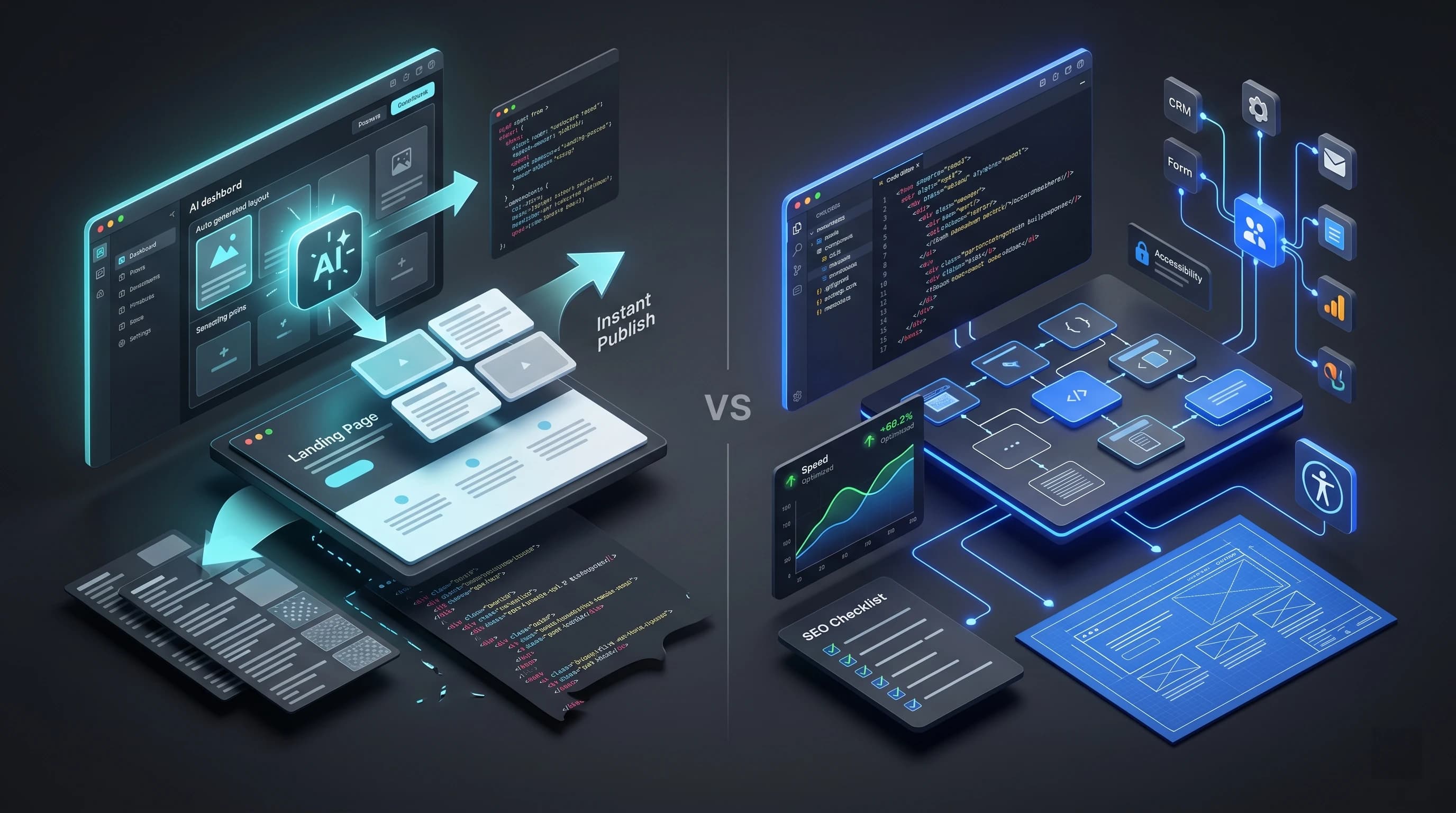
AI Website Builders vs Real Developers: Who Actually Wins in 2026?
AI website builders are not toys anymore. They can generate layouts, suggest copy, produce landing pages, create color systems, and help a business owner go from blank screen to published page faster than ever.
That does not mean they win.
It also does not mean real developers get to ignore them.
The honest answer in 2026 is more interesting: AI wins the first draft. Developers win the business-critical version. The company that actually wins is the one that uses AI for speed without outsourcing judgment to it.
If you are choosing between AI website builders vs developers, the question is not "which one is smarter?" The question is "which one can be trusted with the part of your business this website touches?"
Where AI Website Builders Genuinely Shine
AI builders are great when the risk is low and the goal is speed.
They can help you brainstorm homepage sections, create rough landing page concepts, rewrite weak copy, generate placeholder imagery directions, and test how different offers might sound. If you are validating a small idea, launching a temporary campaign, or getting a simple brochure site online, AI can remove a lot of friction.
This is especially helpful for early-stage businesses that do not yet know whether an offer will stick. A founder can move quickly, publish a basic page, and learn from real conversations before investing in a deeper build.
AI also shines as a creative assistant. It can give you ten headline angles in seconds. It can summarize competitor messaging. It can help non-writers escape the blank page. It can turn a rough outline into a more usable content draft.
That is real value.
But speed is not the same as strategy. A fast website that says the wrong thing to the wrong customer is just a faster way to lose trust.
Where AI Gets Expensive
AI website builders often fail in the places business owners cannot see during launch week.
The design may look polished but still be generic. The copy may sound confident but say nothing specific. The page may load, but the code may be bloated. The site may have service pages, but they may not be structured for technical SEO. The mobile layout may look acceptable on one screen size and fall apart on another. The contact form may work until it needs to connect with your CRM, booking system, analytics, or internal workflow.
This is where "cheap and fast" becomes expensive.
Real business websites have constraints. They need tracking that answers useful questions. They need accessible interfaces. They need content architecture. They need performance budgets. They need redirects during migrations. They need durable components. They need integrations that do not break the first time the business changes a process.
AI can assist with pieces of that work. It cannot own the outcome.
Developers Still Win on Judgment
The biggest advantage of a real developer is not typing code. AI is very good at typing code.
The advantage is knowing what code should exist in the first place.
A strong frontend development process asks better questions before building: What does the visitor need to understand above the fold? Which content must be crawlable? Which scripts are slowing the page down? What happens if the form submission fails? How should the CMS scale when the marketing team adds more pages? What tradeoff are we making between animation and performance? Which component should be reusable, and which one is a one-off?
AI will give you an answer. A developer will challenge the premise.
That matters when the website affects revenue, reputation, hiring, investor trust, sales enablement, or search visibility.
The 2026 Decision Matrix
Use this quick matrix before choosing an AI builder, template builder, freelancer, or developer team.
| Situation | Best fit | Why |
|---|---|---|
| You need a temporary validation page | AI builder | Speed matters more than durability. |
| You need a simple brochure site with a small budget | Template builder | Low complexity and predictable needs. |
| You need better visuals and copy on a small existing site | Freelancer | Focused improvements can go far. |
| You rely on leads, ads, SEO, or sales calls | Developer or agency team | Conversion, tracking, speed, and structure matter. |
| You need custom integrations or CMS workflows | Developer team | The site must fit operations, not just look good. |
| You are replacing a messy site without losing rankings | Developer team | Redirects, metadata, content, and QA carry risk. |
This is not about status. It is about risk. The more the website has to support your business, the less you should treat it like a disposable design prompt.
The Spicy Truth: AI Does Not Know Your Customer
AI can imitate a marketing pattern. It can write a section that sounds like every SaaS homepage, every local service business, every coach, every agency, and every startup that says it helps people "unlock growth."
That is the problem.
Your customer does not need another polished blur of generic confidence. They need specifics. They need proof. They need to understand why you are different, what happens next, how much risk they are taking, and whether you have solved a problem like theirs before.
AI can help sharpen those answers if a human brings real inputs: sales objections, customer language, case studies, analytics, support questions, pricing context, and competitive pressure. Without that, the output often becomes "trust me bro" copy in a nice layout.
That might be enough for a mockup. It is not enough for a growth channel.
Where Developers and AI Work Best Together
The best teams will not reject AI. They will use it carefully.
AI can speed up research, first drafts, test data, copy variations, component scaffolds, documentation, and QA checklists. Developers can then review the output against real requirements: performance, accessibility, maintainability, SEO, security, analytics, and business logic.
This pairing is powerful because it separates generation from responsibility.
For example, AI might draft three landing page structures. A designer can choose the strongest narrative. A developer can build it in a system like Next.js. An SEO strategist can make sure the page is crawlable, internally linked, and aligned with search intent. An engineer can connect forms through system integrations that fit the business process.
That is not slower than AI. It is AI pointed at a better target.
Questions to Ask Before Trusting an AI Website
Before you let an AI builder handle a revenue-facing website, ask these questions:
- Can I edit the content structure without breaking the design?
- Do I own the code, content, and data if I need to move platforms?
- Does the site load fast on real mobile connections?
- Are headings, metadata, internal links, and canonical URLs handled correctly?
- Can forms connect to the tools my team already uses?
- Is the design accessible for keyboard users and screen readers?
- Can I create new pages without duplicating a messy one-off layout?
- Does the copy explain specific customer pain, proof, and next steps?
- Who fixes the site when something breaks?
- What happens when the business outgrows the first version?
If the answer to most of these is "I am not sure," the AI builder may still be useful. It just should not be the final authority.
So Who Actually Wins?
AI wins when the goal is speed, exploration, and low-risk publishing.
Developers win when the goal is performance, reliability, SEO, integrations, accessibility, ownership, and long-term business value.
Business owners win when they stop treating those as enemies.
Use AI to move faster. Use real developers to make sure the thing you ship can carry the weight of your business. If your website is already tied to leads, search, sales, hiring, or trust, talk to Webjectiv before betting the whole thing on a prompt.